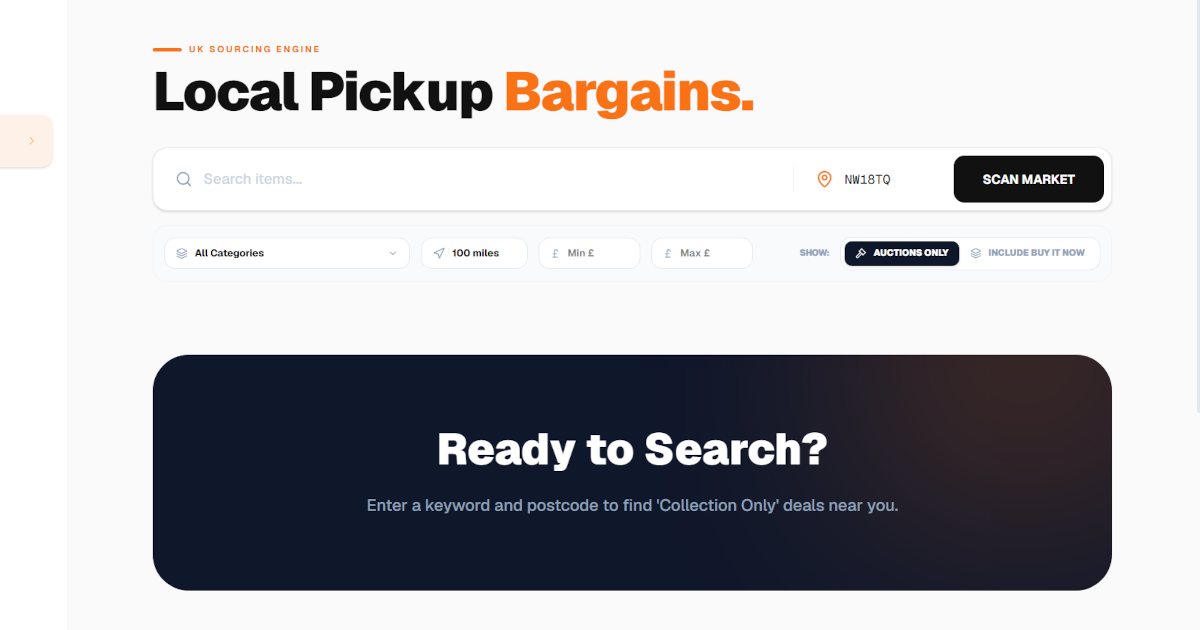
Building FlipSource: Scratching My Own Itch with the eBay API
Every developer has that one project—the one that starts because they were frustrated by a manual process and thought, "I can automate this." For me, that was eBay sourcing.
I’ve always loved the hunt for undervalued tech, but the manual grind of refreshing pages and fighting for "deals" felt like a losing battle. I realized the best margins weren't in the most popular listings, but in the data friction—the listings that were hard to find because of human error or logistical hurdles.
So, I decided to build FlipSource.
The Technical "Aha!" Moment
While digging through the eBay Browse API documentation, I noticed something interesting about how their search engine handles (or doesn't handle) "buying options" and "item location."
The standard search results are optimized for the buyer—showing the most relevant, high-trust listings. But as a reseller, I wanted the least relevant, most "broken" listings. I had to reverse-engineer my query logic:
The "Zero-Bid" Logic: I implemented a specific bid count filter paired with
endingSoonestsorting. This bypasses the psychological "herd mentality" where buyers only bid on items that already have activity.The Radius Trap: One of the biggest challenges was getting the local collection filters to stick. I spent hours debugging why the API would ignore my
pickupRadiusand default to global results. The fix? A strict hierarchy where I had to strip away conflicting country-level filters to let the granular location data take priority.
The Stack: Why Next.js?
I chose Next.js for two reasons: speed and SEO.
Server-Side Logic: When you're scanning for auctions ending in minutes, you can't afford a sluggish client-side experience. I used SSR to ensure the data was as fresh as possible the moment the user hit the dashboard.
Tactile UI: On the front end, I went with Tailwind CSS. I wanted the interface to feel like clean and self explanatory. I added tactile 3D button effects (like the "Compare Sold" button) because when you're in the middle of a high-speed sourcing session, the UI needs to provide instant, physical-feeling feedback.
The "Spelling Mistake" Algorithm
The most fun part of the dev process was the typo generator. I didn't just want a random letter swapper; I wanted it to be realistic. I researched common "fat-finger" mistakes on QWERTY keyboards (like hitting 'k' instead of 'l') and built a utility that generates these permutations. Seeing a "Mackbook" listing pop up with zero bids because of a simple keyboard slip was the ultimate validation of the code.
What I Learned
Building FlipSource taught me that sometimes the most valuable data isn't what's clearly displayed, but what’s hidden behind a poorly optimized listing. From a developer perspective, it was a masterclass in handling complex API filtering and creating a UI that manages high-density data without feeling cluttered.
FlipSource is live now, and while there are always a few bugs in the backlog (as any dev will tell you), seeing it actually surface "hidden gems" in real-time is incredibly satisfying.
Check out the live app: flipsource.co.uk
No thoughts shared yet. Be the first to reply.